





How to Choose the Right SPC Flooring for High-Traffic Commercial Projects in 2026
-
 By Sytech
-
16 Jun, 2026
-


For high-traffic commercial projects in 2026, the right SPC flooring is one with a wear layer of at least 0.5 mm (20 mil), a stone-plastic core density above 2.0 g/cm³, total thickness of 5 mm or more, and a tested, drop-lock joint system rated for commercial use. Get those four numbers right and you have a floor that survives rolling carts, stiletto heels, and daily mopping for 15+ years. Get them wrong — and you'll be replacing planks within 18 months.
Below is the specification framework we use with hotel chains, retail buyers, and contractors sourcing from our factory. It cuts through the marketing labels and focuses on what actually predicts performance.
Start With Wear Layer — Not Plank Thickness
Most buyers obsess over total plank thickness. That's the wrong number to lead with. The wear layer — the transparent PVC film on top — is what determines how long the print stays intact under traffic.
The 0.3 / 0.5 / 0.7 mm rule
- 0.3 mm (12 mil) — residential and very light commercial only. Boutique fitting rooms, private offices.
- 0.5 mm (20 mil) — the workhorse for medium commercial: cafes, clinics, co-working spaces, small retail.
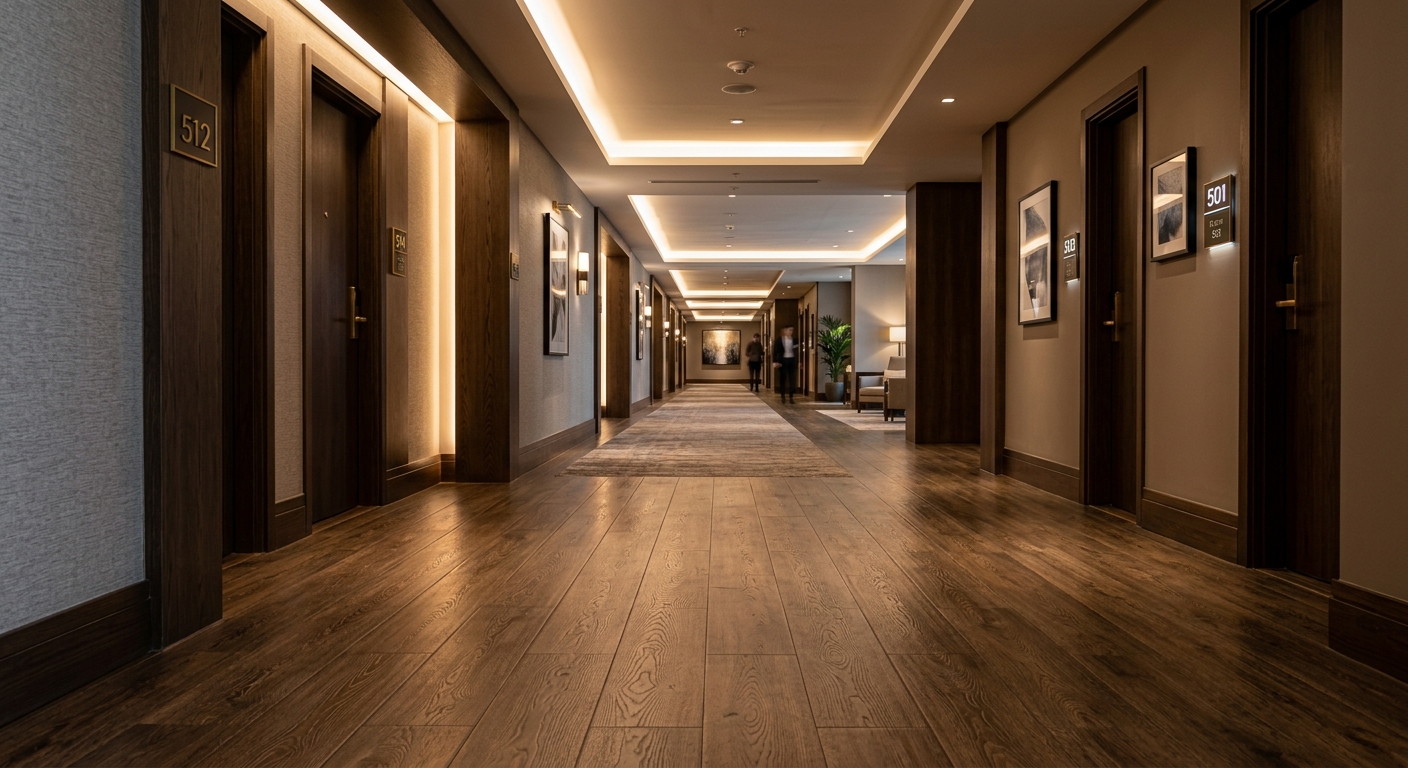
- 0.7 mm (28 mil) and above — hotel corridors, airport lounges, supermarket aisles, school hallways.
A 4 mm plank with a 0.7 mm wear layer will outperform a 6 mm plank with a 0.3 mm wear layer in a busy lobby. Every time. The core gives you stability; the wear layer gives you service life.
Ask your supplier for the wear layer thickness in millimeters, not vague descriptors like “commercial grade.” If they hesitate, that's your answer.
Core Density: The Hidden Spec That Separates Good From Bad
SPC stands for Stone Plastic Composite — roughly 60–70% calcium carbonate bonded with virgin PVC and stabilizers. The ratio matters. A denser core resists indentation from furniture legs, equipment wheels, and point loads.
What to look for
Target a core density of 2.0 g/cm³ or higher for any commercial application. Below 1.85 g/cm³ usually signals filler-heavy material with recycled PVC blended in. You can spot it in the field: lower-density planks feel suspiciously light, sound hollow when tapped, and chip at the edges during installation.
For example, a regional supermarket chain we supply specified 2.05 g/cm³ minimum after they had a previous floor dimple under their checkout queue stanchions within six months. The replacement floor — same visual, denser core — has been flat for four years.
Request a third-party test report (TÜV, SGS, or Intertek) showing density and residual indentation per EN 433. Reputable factories have these on file. If you want to see how we run these checks in-house, our factory overview walks through the QC process.
Locking System: Where Most Commercial Failures Start
Plank gaps in commercial floors almost never come from the plank itself — they come from a weak click system. Foot traffic and rolling loads work joints loose over time, especially in long corridors with no expansion gaps.
Specify a tested commercial-grade lock
- Unilin, Välinge, or I4F licensed locking systems — these are tested for tensile and angle strength.
- Drop-lock on short ends — faster installation and tighter joints than angle-angle systems in long runs.
- Locking strength ≥ 5.0 kN/m on the long edge for heavy commercial.
Generic, unlicensed click profiles often skip the micro-bevel reinforcement at the joint. They install fine. They fail in month nine. For projects above 1,000 m², always insist on a named, licensed system — the royalty cost is marginal versus a callback.
Match the Surface Finish to the Cleaning Regime
A beautiful matte finish in a restaurant kitchen is a maintenance nightmare. Conversely, a high-gloss plank in a daylight-flooded hotel lobby will show every scratch by week two. Surface texture has to match how the space is cleaned and lit.
Four finishes, four use cases
- EIR (Embossed in Register) — deep wood grain texture, hides micro-scratches, best for hospitality and retail with mixed traffic.
- Matte / soft-touch — premium look, but shows greasy footprints; reserve for offices and showrooms.
- Hand-scraped — strong residential character, works in boutique hotels and themed restaurants.
- Slip-resistant (R10/R11) — mandatory for bathrooms, pool decks, and food service zones. Verify with DIN 51130 test data.
An anti-bacterial or anti-scratch UV coating on top of the wear layer adds another 20–30% to scratch resistance. For healthcare and education projects, it's worth the upcharge.
Don't Skip the Underlay Conversation
The pre-attached pad on the back of an SPC plank affects acoustics, foot comfort, and — critically — how the floor performs over a slightly uneven subfloor.
IXPE vs EVA vs cork
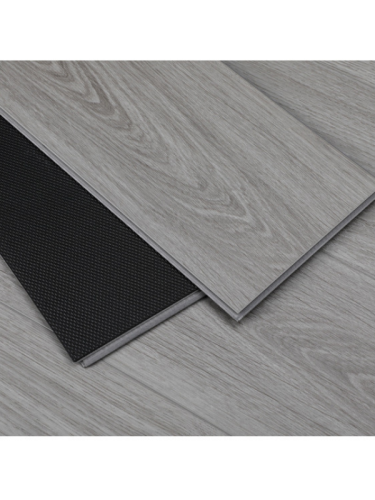
IXPE (1.5 mm) is the standard for commercial: closed-cell, moisture-resistant, won't compress permanently. Acoustic rating around 19 dB impact noise reduction.
EVA is cheaper but compresses over time — fine for residential, risky in commercial.
Cork backing pushes acoustic performance above 21 dB and is favored in hotels where guests above need quiet floors below.
One detail buyers miss: an attached pad lets the floor tolerate up to 2 mm of subfloor variation per 2 m. Without it, the spec usually drops to 1 mm — meaning more grinding and self-leveling before install. On a 5,000 m² hotel project, that's real money.
Plan for Expansion, Heat, and Light
SPC is dimensionally stable — but not inert. It still moves with temperature, and large unbroken spans amplify that movement.
Three field rules
- Expansion gap — leave 8–10 mm at every wall and vertical obstruction. For runs over 15 m, add an intermediate expansion joint.
- Heat exposure — quality SPC tolerates surface temperatures up to 60°C. Behind south-facing curtain walls or near radiators, verify the supplier's heat stability test (typically ≤0.15% dimensional change at 80°C).
- UV stability — for spaces with direct sunlight, ask for color fastness ≥ Grade 6 on the Blue Wool Scale. Lower-grade prints fade within two summers.
A contractor we supplied for a beachfront restaurant in the Mediterranean specified Grade 7 fastness after a previous installation faded unevenly under skylights. Three years in, the replacement still matches the original sample.
Fire, VOC, and Slip Certifications Buyers Should Demand
Commercial projects increasingly fail handover inspections because of missing or outdated certificates. Build the documentation requirement into your purchase order, not as an afterthought.
Minimum certification stack for 2026
- Fire rating — EN 13501-1 Class Bfl-s1 (Europe) or ASTM E648 Class I (North America). For hospitals, schools, and airports this is non-negotiable.
- VOC emissions — FloorScore, Indoor Air Comfort Gold, or CDPH v1.2 certified. LEED v4.1 projects will reject anything else.
- Slip resistance — DIN 51130 R9–R11 depending on the room.
- Phthalate-free / REACH compliant — increasingly required across EU and Middle East tenders.
Ask the supplier to issue certificates that match the production batch you're buying — not generic ones from a different SKU two years ago. Real factories will do this without pushback.
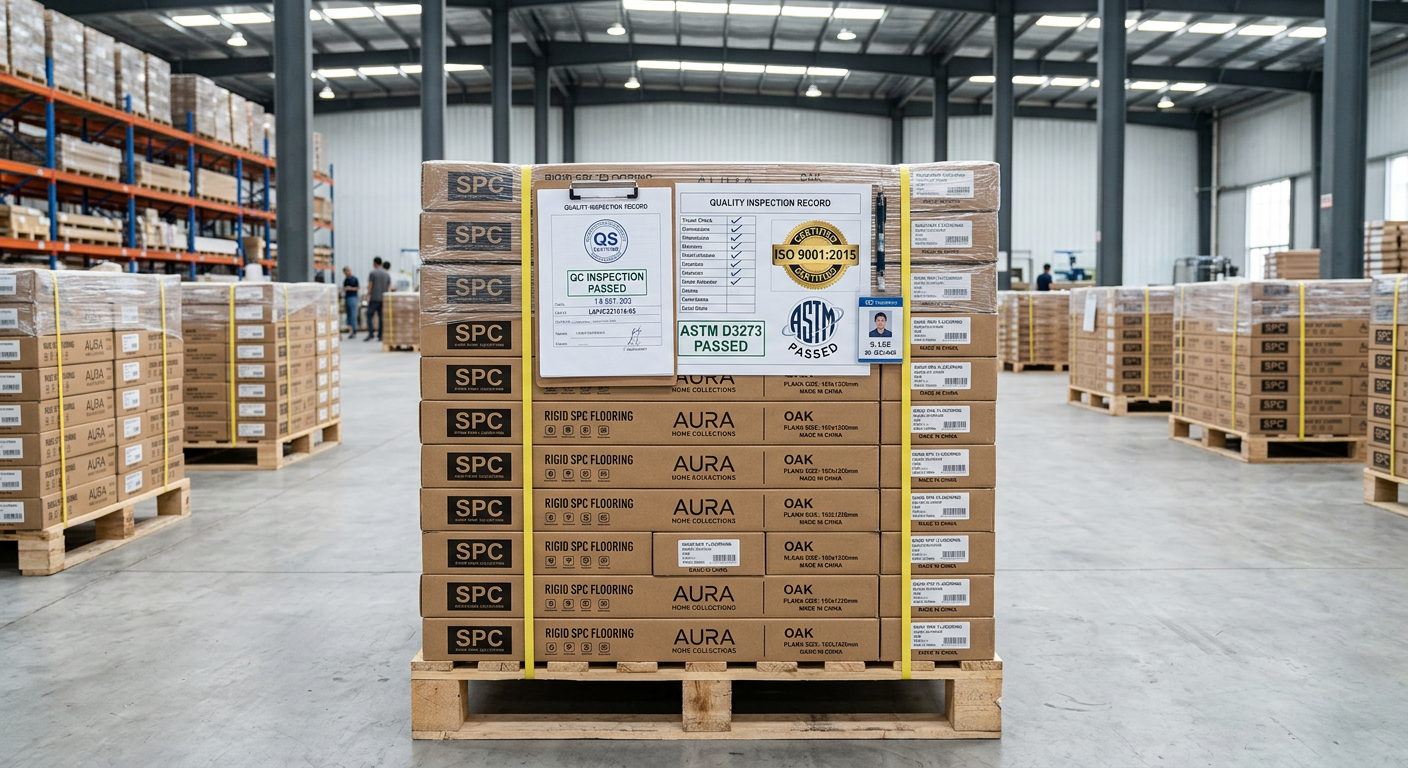
Sourcing Smart: Sample, Audit, Order
The biggest sourcing mistake in commercial SPC is jumping from sample approval straight to a full container. Sample planks are often hand-picked; production reality varies. Bridge the gap with a structured process.
A three-step sourcing checklist
- Reference sample — request a labeled sample with wear layer, density, and lock system printed on the back. Keep it for batch comparison on arrival.
- Pre-production sample (PPS) — for orders above 2,000 m², require a PPS from the same line that will run your order. Approve in writing.
- In-line and pre-shipment inspection — third-party (SGS/BV) or factory-supplied with video. Verify density, dimensions, lock fit, and visual defects per AQL 2.5.
A boutique hotel group we work with adds one more step: they ship one full pallet for mock-up installation before approving the balance. It adds two weeks to the timeline and has prevented two color-mismatch disasters in five years.
For more on what to look for during factory selection — and the kind of equipment that separates serious manufacturers from traders — browse our product range and the showroom. If you've been burned on outdoor materials too, our earlier guide on why WPC decking cracks, fades, or warps covers the same QC mindset applied to decking.
Quick Specification Cheat Sheet for 2026
If you only remember one page from this article, make it this one. Use it as a starter spec when sending RFQs.
For medium-to-heavy commercial projects
- Total thickness: 5.0–6.0 mm including pad
- Wear layer: 0.5 mm minimum, 0.7 mm preferred
- SPC core density: ≥ 2.0 g/cm³
- Locking system: licensed Unilin, Välinge, or I4F drop-lock
- Underlay: 1.5 mm IXPE (cork for hospitality)
- Fire: Bfl-s1 or ASTM E648 Class I
- VOC: FloorScore certified
- Slip: R10 minimum, R11 in wet zones
- Color fastness: Blue Wool Grade 6+
- Warranty: 10-year commercial minimum
Send this list to three suppliers. Compare the ones who answer with test reports against the ones who answer with adjectives. The choice usually becomes obvious.
Bringing It Together
Specifying commercial SPC flooring well comes down to four pillars: a thick enough wear layer for the traffic, a dense enough core for the loads, a tested locking system, and certifications that match your project's compliance demands. Everything else — color, format, finish — is design preference layered on top of that engineering foundation.
If you're preparing a tender for 2026 — whether it's a 500 m² boutique or a 50,000 m² mixed-use development — our team can help you match the right SPC build to your traffic class, climate, and budget. Drop your project details on our contact page and we'll send back a spec sheet, samples, and pricing within two working days.
-
PVC vs WPC vs SPC Wall Panels: Which One Wins for Your Project?
09 Jun, 2026
-
UV Marble Sheet Buying Guide: How to Source the Right Panels in 2026
09 Jun, 2026
-
WPC Decking Maintenance Tips: A Practical Care Guide for Long-Lasting Outdoor Decks
09 Jun, 2026
-
UV Marble Panels in Hotel Lobbies: 5 Real Projects That Replaced Real Stone
09 Jun, 2026